
Hyundai Elantra (CN7): Front Radar System / Smart Cruise Control (SCC) Switch
Schematic diagrams
| Circuit Diagram |

Repair procedures
| Inspection |
| 1. | Check for resistance between terminals in each switch position (LH).
[LH : Audio + Hands free]
|

| 2. | Check for resistance between terminals in each switch position (RH).
[Cruise]
[Trip]
|
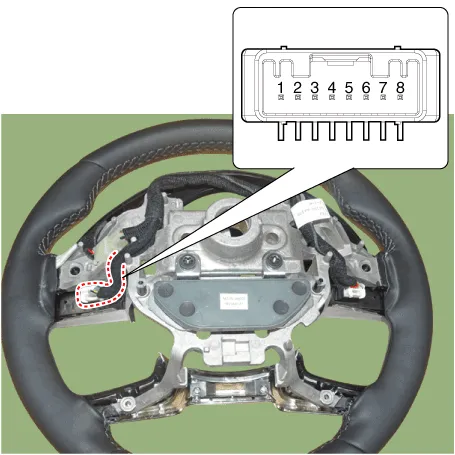
| Removal |
| 1. | Disconnect the negative (-) battery terminal. |
| 2. | Remove the steering wheel assembly. (Refer to Steering System - "Steering Wheel") |
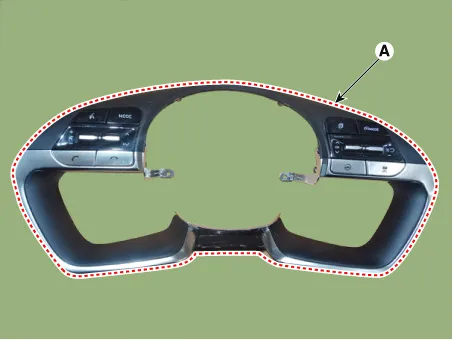
| 3. | Remove the steering back cover (A).
|

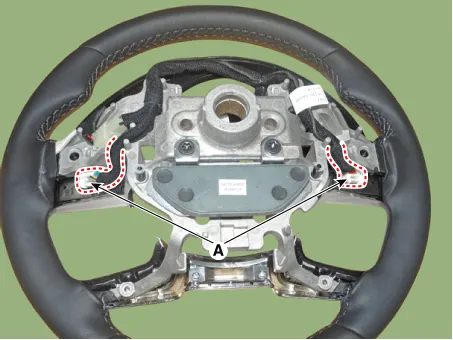
| 4. | Remove the steering remote control connector (A).
|
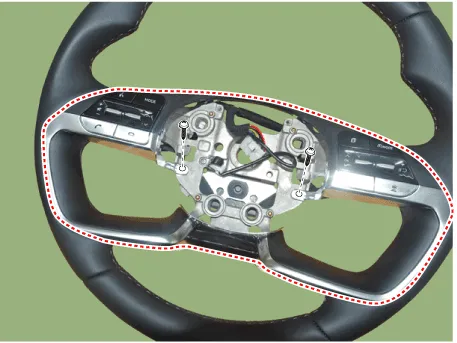
| 5. | Remove the steering remote control(Switch (A)) after loosening the screws.
|
| Installation |
| 1. | Install the steering wheel remote control after connecting the connector. |
| 2. | Install the steering wheel. |
| 3. | Connect the negative (-) battery terminal. |
Components and components location Components Location1. Front rader unit Specifications Specification Item Specification Power supply (V)12Operation voltage (V)9 - 16 Schematic diagrams Circuit DiagramTerminal function Pin No Terminal function 1GROUND2L-CAN HIGH3L-CAN LOW4C-CAN HIGH5C-CAN LOW6IGN Repair procedures InspectionInspection procedure for vehicle with Forward Collision-Avoidance Assist and Smart Cruise Control system failure 1.
Other information:
Hyundai Elantra (CN7) 2021-2026 Service Manual: Repair procedures
Diagnosis with Diagnostic tool1.In the body electrical system, failure can be quickly diagnosed by using the vehicle diagnostic system (Diagnostic tool).The diagnostic system (Diagnostic tool) provides the following information.(1)Fault Code Searching : Checking failure and code number (DTC)(2)Data Analysis : Checking the system input/output data s
Hyundai Elantra (CN7) 2021-2026 Service Manual: Immobilizer Control Unit
Components and components location Components (1)With Smart KeyConnector Pin Information Pin no Connector A Connector B Connector C Connector D Connector E 1ESCL
Categories
- Manuals Home
- Hyundai Elantra Owners Manual
- Hyundai Elantra Service Manual
- Integrated Thermal Management Module (ITM)
- Vehicle Information
- Function settings
- New on site
- Most important about car
