
Hyundai Elantra (CN7): Airbag Module / Passenger Airbag (PAB) Module
Description and operation
| Description |
|

Components and components location
| Components |
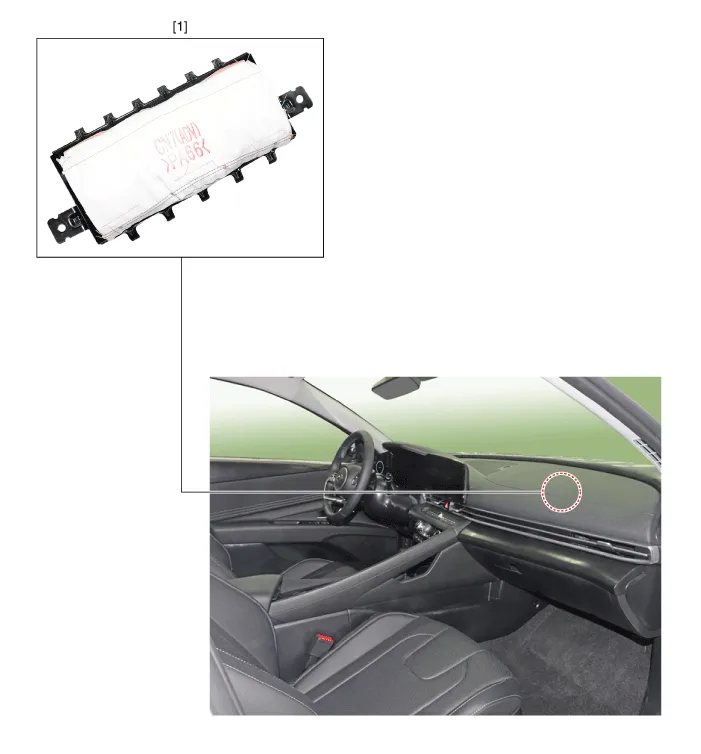
| 1. Passenger airbag (PAB) |
Repair procedures
| Removal |
| 1. | Disconnect the negative (-) battery terminal.
|
| 2. | Remove the main crash pad assembly. (Refer to Body (Interior and Exterior) - "Main Crash Pad Assembly") |
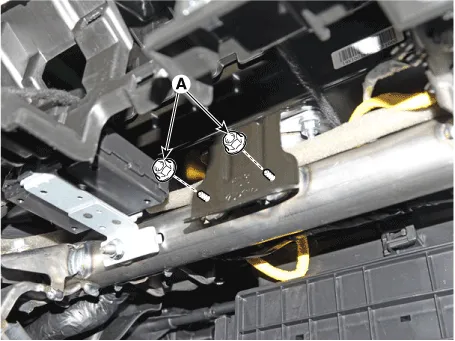
| 3. | Loosen the passenger airbag mounting nuts (A).
|
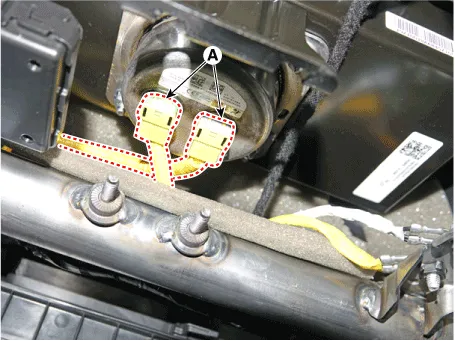
| 4. | Disconnect the PAB module connector (A).
|
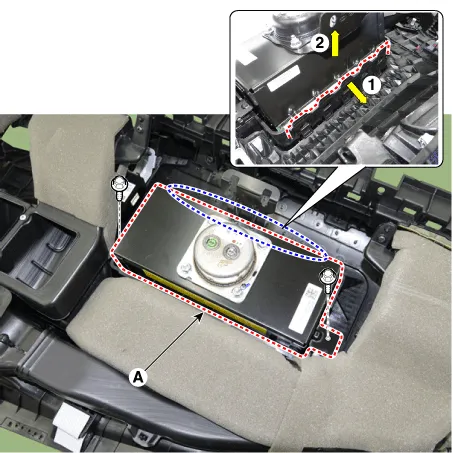
| 5. | Remove the PAB module (A) after loosening the mounting bolts.
|


| Installation |
| 1. | Check if the battery (-) cable is disconnected.
|
| 2. | Place a passenger airbag (A) on the crash pad and tighten the passenger airbag mounting bolts.
|
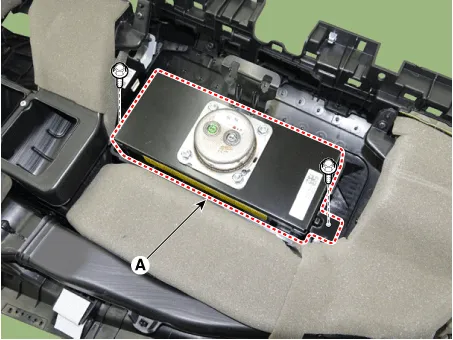
| 3. | Install the main crash pad assembly. (Refer to Body (Interior and Exterior) - "Main Crash Pad Assembly") |
| 4. | Connect the PAB module connector (A).
|
| 5. | Tighten the passenger airbag mounting nuts (A).
|
| 6. | Reconnect the battery negative (-) terminal. |
| 7. | After installing the passenger airbag, confirm proper system operation.
|
Description and operation Description• Driver Airbag (DAB)DAB is installed in the steering wheel, and electrically connected to the SRSCM via clock spring.
Description and operation DescriptionThe Side Airbags (SAB) are installed inside the front seat and protects the driver and passenger from danger when a side crash occurs.
Other information:
Hyundai Elantra (CN7) 2021-2026 Service Manual: Compressor oil
Repair procedures Oil Specification1.The HFC-134a system requires synthetic (PAG) compressor oil whereas the R-12 system requires mineral compressor oil. The two oils must never be mixed.2.Compressor (PAG) oil varies according to compressor model. Be sure to use oil specified for the model of compressor.
Hyundai Elantra (CN7) 2021-2026 Service Manual: Description and operation
Description and OperationBlcok Diagram • This system monitors the driving situations through the radar and the camera. Thus, for a situation out of the sensing range, the system may not normally operate. The System may be limited when : • The radar sensor or camer
Categories
- Manuals Home
- Hyundai Elantra Owners Manual
- Hyundai Elantra Service Manual
- Instrument Cluster
- Maintenance
- General Tightening Torque Table. General information
- New on site
- Most important about car
